

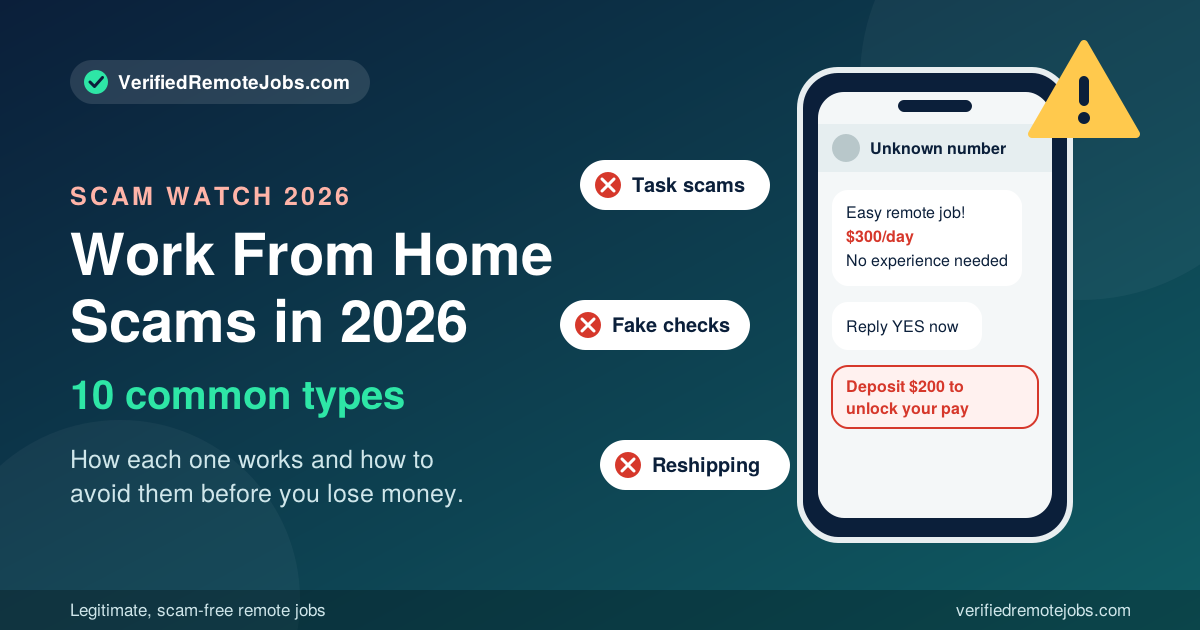
Work from home scams are not new, but they have never been this common or this convincing. As more people search for remote jobs, scammers have followed them, adapting their tactics to new technology, new platforms, and new fears.
This guide covers the ten most common work from home scams in 2026, how each one works, the warning signs, and the simple habits that protect you from all of them.
Work From Home Scams in 2026: What the Numbers Show
Federal Trade Commission data shows that reported losses to job scams grew from about $90 million in 2020 to roughly $501 million in 2024, more than a fivefold increase in four years. The Better Business Bureau reported that employment scams more than doubled in 2025, and it points to the popularity of remote work and the growing use of artificial intelligence to write realistic fake job listings and recruiter messages as contributing factors.
There are two other things worth knowing. First, these figures only count people who reported the scam, and most victims never do, so the real losses are higher. Second, scams are increasingly starting on phones and social media, through unexpected text messages, WhatsApp chats, and direct messages, instead of traditional job boards.
The pattern is clear: the scams are growing, but the tactics behind them are surprisingly consistent. Learn the patterns and you can avoid nearly all of them.
The 10 Most Common Work From Home Scams
1. Task scams (gamified "app optimization" jobs)
This is one of the fastest-growing scams. You get an unexpected text or message offering easy online work: rating products, boosting app rankings, watching videos, or "optimizing" listings. You complete a few tasks and even receive a small payout, which builds trust. Then the platform tells you that to unlock bigger earnings you must deposit your own money, often in cryptocurrency. Every deposit is lost, and the requested amounts keep growing.
Warning signs: Unsolicited recruiter message, a job that pays per click or rating, a dashboard showing growing "earnings," and any request to deposit money to continue.
How to avoid it: A real job never requires you to pay in order to earn. If you are asked to deposit funds, stop immediately.
2. Fake check scams
The "employer" sends you a check, often for supplies or equipment, and tells you to deposit it and then send part of the money to a vendor, or to buy gift cards. Banks may make the funds available quickly, but the check is fake and bounces days later. You are responsible for the full amount, and the money you sent is gone.
Warning signs: A check arrives before you start work, you are told to keep some money and send the rest, or you are told to buy equipment from a specific seller.
How to avoid it: Never deposit a check and send money to someone else. Real employers do not ask for this.
3. Reshipping and package-handling scams
You are hired as a "shipping coordinator" or "quality inspector." Your job is to receive packages at home, repackage them, and send them to another address, often overseas. The goods are typically bought with stolen credit cards, and you become the person who helped move them, which can create legal trouble for you.
Warning signs: The job involves receiving and forwarding packages from your own home, or the company has no warehouse or business address.
How to avoid it: Be extremely cautious with any role that has you receive and reship goods or forward money.
4. Payment processing and money-moving jobs
Titles like "payment processor," "financial agent," or "transaction coordinator" often hide money laundering. You receive funds in your own bank account and transfer them elsewhere, keeping a commission. Legitimate-looking payments may be the proceeds of other fraud, and your account can be frozen or closed.
Warning signs: You are asked to use your personal bank account to receive and forward money for a company.
How to avoid it: Never use your personal accounts to move money for an employer you cannot fully verify.
5. Fake equipment and software fees
You are "hired" and then told to buy a laptop, software, or a security kit from a particular vendor, with a promise of reimbursement. The vendor is controlled by the scammer, and the reimbursement never arrives.
Warning signs: You are required to pay up front for equipment before your first paycheck.
How to avoid it: Legitimate employers ship equipment directly or reimburse through a standard expense process, and they do not make you pay a specific vendor.
6. Training, certification, and background check fees
Some scammers charge for "mandatory training," a "certification," or a "background check" before you can start. You pay, and the job never starts. Some follow up with more fees.
Warning signs: Any fee that you must pay in order to be hired.
How to avoid it: Employers pay for their own hiring and onboarding costs. If you are asked to pay, it is a scam.
7. Fake recruiter and company impersonation scams
Scammers pretend to be recruiters from real, well-known companies. They copy real job descriptions, create lookalike email addresses and social media profiles, and run realistic-sounding interviews, often over chat. Their goal is to collect personal information or money. AI tools make these messages and listings look more professional than ever, so poor spelling is no longer a reliable clue.
Warning signs: The recruiter writes from a non-company email address, refuses a phone or video call, or the job cannot be found on the real company's careers page.
How to avoid it: Confirm every offer through the company's official website, using contact details you find yourself.
8. Data harvesting and identity theft "applications"
The application form is the scam. You are asked for your Social Security number, bank details, a photo of your ID, or a copy of your passport for "onboarding" or "direct deposit setup," often before there is any real offer. The information is used for identity theft or sold.
Warning signs: Requests for sensitive information before a written offer, or through a link that does not belong to the company.
How to avoid it: Only provide sensitive details after you have verified the employer and received a formal written offer, and only through the company's official systems.
9. Classic "easy money" jobs: data entry, envelope stuffing, product assembly
These old schemes are still around. They promise big pay for simple work, but first require you to buy a starter kit, a directory, or training materials. After you pay, there is little or no real work.
Warning signs: Pay that is far higher than market rates, "no experience needed," and an upfront cost.
How to avoid it: Compare the pay with similar jobs on trusted job boards, and walk away from anything that sounds too good to be true.
10. Fake job listings and cloned job boards
Scammers post fake jobs on real job sites, social media, and community groups. Some build entire fake job boards or recruiting agencies to attract applicants and collect their data.
Warning signs: The listing has no company name, a very new website, or the apply button leads somewhere unrelated to the employer.
How to avoid it: Prefer job boards that verify employers, and check every employer yourself before sharing personal information.
Where These Scams Start
Knowing where scammers find you helps you stay alert.
- Text messages and WhatsApp: Unexpected "recruiter" messages that appear out of nowhere. Real recruiters rarely begin with a cold text offering a job you never applied for.
- Social media: Fake job posts, direct messages, and ads on platforms like Facebook, Instagram, and LinkedIn.
- Email: Messages that say your resume was "selected," often linked to a resume you posted online.
- Job boards: Even reputable sites can contain a few fake listings, which is why independent verification matters.
- Messaging apps and group chats: Telegram and similar apps where fake "interviews" and task platforms are run.
How to Protect Yourself From Any Work From Home Scam
You do not need to memorize every scam type. These habits cover almost all of them.
- Never pay to get a job. No fees, no kits, no certifications, no deposits.
- Never move money for an employer. No forwarding payments, no depositing checks and sending funds, no gift cards.
- Insist on a real interview. A phone or video conversation with a real person is the minimum.
- Verify the company independently. Check the official website, the careers page, LinkedIn, and reviews. Our 10-minute verification checklist walks you through it.
- Keep sensitive information private until you have a verified, written offer.
- Slow down. Urgency is the scammer's favorite tool. Real employers give you time.
- Don't click unknown links or open unexpected attachments from recruiters you have not verified.
- Use verified job boards that screen employers before listing them.
- Trust your instincts. If something feels off, it usually is.
What to Do If You Think You've Been Scammed
Act quickly. The sooner you respond, the more you can limit the damage.
- Stop all contact with the supposed employer.
- Call your bank or card issuer right away if you sent money, shared account information, or deposited a suspicious check.
- Change your passwords and turn on two-factor authentication, especially for email and banking.
- Consider a fraud alert or credit freeze if you shared your Social Security number.
- Report it to the FTC at ReportFraud.ftc.gov, the FBI's Internet Crime Complaint Center at ic3.gov, and the platform where you found the job.
- Don't pay recovery fees. People who contact you offering to recover your lost money for a fee are usually running a second scam.
It is easy to feel embarrassed, but remember that these scams are designed by professionals and fool people of every age and background. Reporting helps protect others.
Frequently Asked Questions
What is the most common work from home scam right now?
Task scams, where you complete simple online tasks and are then asked to deposit your own money, make up a large share of reported job scams, along with fake check scams, fake recruiter scams, and reshipping scams.
Why do work from home scams keep increasing?
Remote work is popular, hiring happens online, and technology makes it easy to create convincing fake listings and recruiter messages at scale. Scammers also know that many job seekers are under financial pressure and may act quickly.
Is a job offer by text message legitimate?
Usually not, if you did not apply or give the company your number. Real recruiters sometimes use text to schedule interviews, but an unsolicited text offering easy work is a classic scam opener.
Can a real company ask me to buy my own equipment?
Legitimate companies typically provide equipment or reimburse you through a normal process. They do not require you to buy from a specific vendor or send you a check to deposit and forward.
How do I know if a remote job is real?
Confirm the job on the company's official careers page, verify the recruiter, check reviews, and make sure you had a real interview and received a written offer before sharing sensitive information.
Where can I report a work from home scam?
In the United States, report to the FTC at ReportFraud.ftc.gov and the FBI's IC3 at ic3.gov. Also report the listing to the website or app where you saw it.
Final Thoughts
Work from home scams change their clothing, but the body underneath stays the same: they ask for your money, your personal information, or your help moving funds, and they rush you before you can think. Hold on to a few simple rules, never pay to work, never move money for an employer, always verify, and never rush, and you will be safe from almost everything out there.
There are plenty of real, well-paying remote jobs. Find verified, scam-free remote jobs at VerifiedRemoteJobs.com and apply with confidence.
Comments (0)
No comments yet. Be the first to join the conversation.