

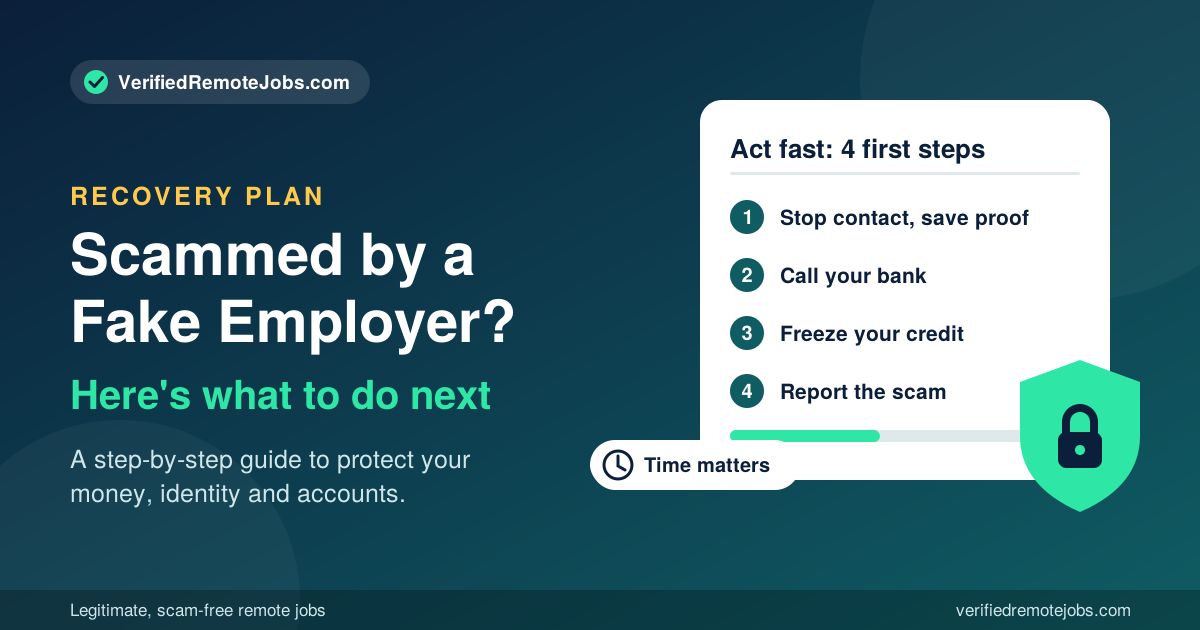
If you just realized that the job, the recruiter, or the paycheck was fake, take a breath. You are not alone, and you are not foolish. Job scams are built by professionals who study how to sound convincing, and they fool smart, careful people of every age and background every day.
What matters now is speed and order. The steps below are arranged by urgency, so you can start at the top and work your way down. Not every step applies to every situation, so use the section that matches what you lost: money, personal information, or access to your accounts and devices.
A quick note: the reporting steps in this guide are for the United States. If you live elsewhere, the same principles apply, and your national consumer protection agency or police cybercrime unit will have its own reporting portal.
Step 1: Stop All Contact (Right Now)
Cut off communication with the fake employer. Do not reply to messages, answer calls from their numbers, or click any more of their links. Do not argue or confront them, because scammers sometimes respond to pushback with threats or by asking for more money.
Before you block them, take screenshots and save everything you can. This evidence will help your bank and investigators:
- The original job posting and any messages, emails, or texts
- The recruiter's name, email address, phone number, and profile links
- Payment records, receipts, check images, transaction IDs, and wallet addresses
- Any documents you signed or forms you filled out
Then block their numbers and email addresses.
Step 2: If You Lost Money, Act on It Immediately
The sooner you contact the company that handled the payment, the better your chances of limiting the loss. Recovery is never guaranteed, but delays almost always make it harder.
If you sent a bank transfer or wire
Call your bank's fraud department right away and explain that you were the victim of a scam. Ask whether the transfer can be recalled or reversed. Give them the recipient details and your saved records.
If you paid with a credit or debit card
Call the number on the back of your card, report the charge as fraud, and ask to dispute it. Ask for the card to be canceled and replaced.
If you deposited a fake check and sent money out
Tell your bank immediately that the check was part of a scam. Fake checks can take days or weeks to be returned, and you are responsible for the amount if the check bounces, so it is important to tell the bank as soon as possible. Do not spend or transfer any more of the funds.
If you paid with gift cards
Contact the gift card company right away using the number on the card or its official website. Give them the card numbers, receipts, and any other details. Report the scam to the retailer where you bought the cards as well.
If you used a payment app such as Zelle, Cash App, Venmo, or PayPal
Report the scam through the app and contact the bank or card linked to it. Some apps can investigate fraud claims, but reversing transfers can be difficult, so report quickly.
If you paid with cryptocurrency
Contact the exchange or wallet service you used and report the transaction. Crypto transfers are very hard to reverse, but exchanges can sometimes flag accounts that received stolen funds. Report the wallet address to the FTC and the FBI as well.
Step 3: If You Shared Personal Information, Lock Down Your Identity
If you gave the fake employer your Social Security number, date of birth, driver's license, passport, or bank details, you need to guard against identity theft.
Place a credit freeze
A credit freeze stops new credit accounts from being opened in your name. In the United States it is free, and you place it with each of the three credit bureaus: Equifax, Experian, and TransUnion. It does not affect your existing accounts or your credit score, and you can lift it temporarily when you apply for credit.
Or place a fraud alert
A fraud alert tells lenders to verify your identity before opening new credit. It is also free. A credit freeze offers stronger protection, but a fraud alert is a good option if you do not want to freeze your files.
Check your credit reports
You can get free reports from the three bureaus at AnnualCreditReport.com. Look for accounts, inquiries, or addresses you do not recognize.
Visit IdentityTheft.gov
The FTC's IdentityTheft.gov website helps you report identity theft and creates a personal recovery plan with step-by-step instructions and sample letters.
Watch for misuse of your Social Security number
Create or sign in to your my Social Security account so no one else can create one in your name. If you are concerned about tax fraud, the IRS offers an Identity Protection PIN that helps prevent someone else from filing a return using your number.
Protect your bank accounts
If you shared account details, tell your bank so it can monitor or close the account and issue new account numbers. Review your statements carefully for the next several months.
Step 4: Secure Your Accounts and Devices
If you clicked a link, downloaded a file, installed software, or gave someone remote access to your computer, assume your device may be compromised.
- Change your passwords, starting with your email, banking, and any account that shares a password with another one. Use a new, unique password for each.
- Turn on two-factor authentication wherever it is offered, preferably with an authenticator app instead of text messages.
- Remove remote access. Uninstall any remote-control software the scammer asked you to install, such as screen-sharing tools you do not recognize.
- Run a security scan with a trusted antivirus or anti-malware program. If you are unsure, take the device to a professional.
- Check your email settings for forwarding rules or unfamiliar connected apps.
- Warn your contacts if the scammer accessed your email or social accounts, since they may be messaged next.
Step 5: Report the Scam
Reporting does not guarantee you will get your money back, but it helps investigators spot patterns, shut down operations, and warn others. Report to:
- The Federal Trade Commission: ReportFraud.ftc.gov
- The FBI's Internet Crime Complaint Center (IC3): ic3.gov, especially if you lost money or the crime involved the internet
- The job site or platform where you found the listing, so they can remove it
- The Better Business Bureau: its Scam Tracker helps warn other job seekers
- Your local police, if you lost money or your identity was stolen, since a police report can help with bank and credit disputes
- The company being impersonated, if the scammer posed as a real business, so it can warn others
Have your screenshots and transaction records ready when you file.
Step 6: Watch Out for Recovery Scams
After you report a scam, you may be contacted by someone who claims they can recover your lost money for a fee. They may pose as a government agent, a lawyer, a crypto recovery expert, or even the original scammer's "victim support team." This is a second scam, and victims are frequently targeted again.
- Real government agencies do not charge fees to help you recover money.
- Be skeptical of anyone who guarantees you will get your money back.
- Never pay upfront fees, gift cards, or crypto to a "recovery service."
- Be wary of anyone who contacts you out of nowhere after you reported a scam.
Step 7: Take Care of Yourself
Scams do more than drain bank accounts. Many victims feel shame, anger, anxiety, or depression, especially when the scam took place during a job search, when money was already tight. Those feelings are normal, and none of them are your fault.
- Talk to someone you trust, whether that is a friend, a family member, or a counselor.
- If the loss is putting your housing or bills at risk, contact your lenders and utility providers early. Many have hardship options.
- Consider speaking with a nonprofit credit counselor if the financial impact is serious.
- Give yourself time. Recovery takes a while, and it gets easier.
If you are feeling overwhelmed or hopeless, please reach out for support. In the United States you can call or text 988 to reach the Suicide and Crisis Lifeline at any time.
Quick Action Checklist
Here is the short version to keep handy:
- Stop contact and save all evidence
- Call your bank, card company, or payment app about any money lost
- Freeze your credit if you shared personal information
- Change passwords and turn on two-factor authentication
- Remove any remote access software and scan your device
- Report to the FTC, the FBI's IC3, and the job site
- Ignore anyone offering to recover your money for a fee
- Ask for support from people you trust
How to Avoid Getting Scammed Again
Once the immediate steps are done, use what you learned to protect yourself on your next search.
- Learn the warning signs in our guide to the 15 red flags of a remote job scam.
- Run every new opportunity through a verification checklist, such as our 10-minute check for any remote job.
- Review the most common work from home scam types so you recognize them early.
- Never pay to get a job, never move money for an employer, and never share sensitive information before a verified, written offer.
- Use job boards that screen employers before listing them.
Frequently Asked Questions
Can I get my money back after a job scam?
Sometimes, but not always. Your chances are best if you contact your bank, card issuer, or payment service immediately, since transfers and payments can be easier to dispute or stop in the first hours and days. Reporting the scam helps investigators even when money cannot be recovered.
I gave a fake employer my Social Security number. What now?
Place a credit freeze with Equifax, Experian, and TransUnion, check your credit reports at AnnualCreditReport.com, report the situation at IdentityTheft.gov, and consider creating a my Social Security account and requesting an IRS Identity Protection PIN.
What if I deposited a fake check and already sent money?
Tell your bank right away that the check was part of a scam. Do not move any more of the money. You may owe your bank the amount of the check if it bounces, so quick communication matters.
Should I report a job scam even if I did not lose money?
Yes. Reports of attempted scams help the FTC and other agencies track trends and warn others. Report the listing to the platform where you found it as well.
Will the police help with a job scam?
You can file a police report, which can help with bank and credit disputes. Local police may not be able to investigate scammers located in other places, which is why reporting to the FTC and the FBI's IC3 is also important.
How do I know if someone offering to recover my money is legitimate?
Assume they are not if they charge a fee, guarantee results, or contacted you first. Real government agencies do not charge to help you recover lost money.
Final Thoughts
Getting scammed by a fake employer is stressful, but acting quickly and in the right order can limit the damage. Stop contact, call your bank, protect your identity, secure your accounts, and report what happened. Then be gentle with yourself. These scams succeed because they are carefully designed to work on good, hopeful people.
When you are ready to start looking again, browse verified remote jobs at VerifiedRemoteJobs.com and search with confidence.
Comments (0)
No comments yet. Be the first to join the conversation.