

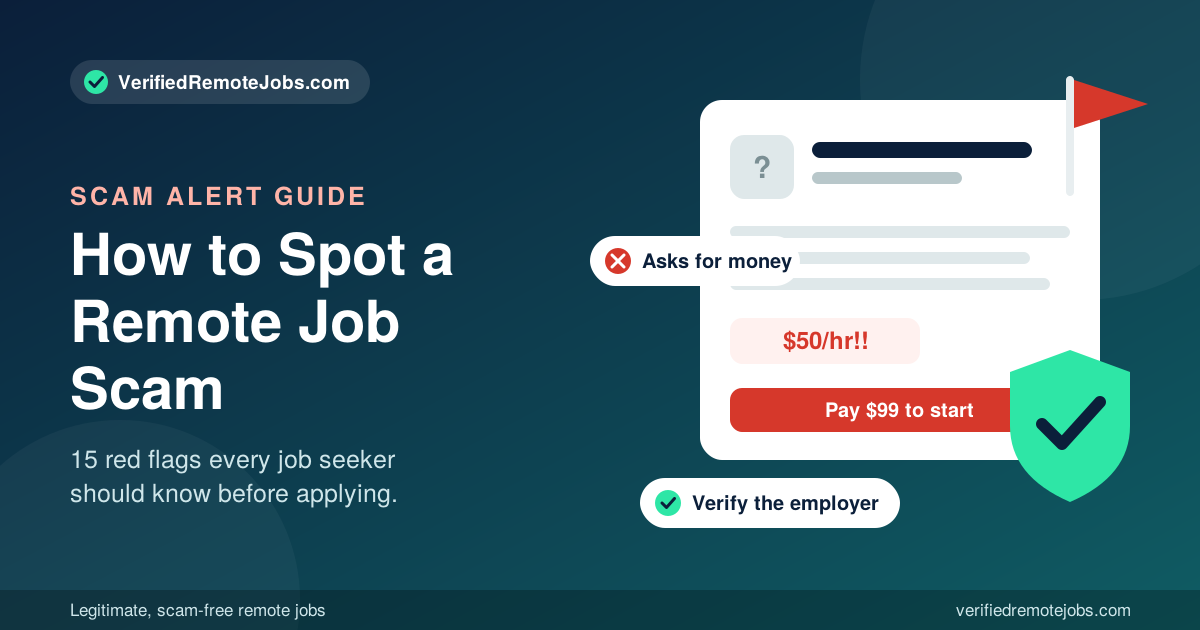
Remote work has opened the door to great careers, and it has also opened the door to scammers. Fake employers know that millions of people are searching for work from home jobs, and they build convincing job postings, websites, and even interview processes to steal money, personal information, or both.
The good news is that nearly every remote job scam follows the same patterns. Once you know the warning signs, they become easy to spot. This guide covers the 15 biggest red flags, the most common scam types, how to verify any employer, and exactly what to do if you think you have been targeted.
Why Remote Job Scams Are So Common
Scammers love remote jobs for three reasons. First, there is no office to visit, so it is harder for you to confirm the company exists. Second, remote hiring happens entirely online, which is exactly where scammers operate. Third, job seekers are often in a hurry, especially when they need income, and rushed people make easier targets.
According to the U.S. Federal Trade Commission, job scams cause hundreds of millions of dollars in reported losses every year, and the real number is likely higher because many victims never report it. Anyone can be fooled, no matter how experienced or careful they are. Knowing what to look for is your best protection.
15 Red Flags of a Remote Job Scam
1. They ask you to pay money up front
This is the biggest red flag of all. A real employer pays you. You should never have to pay for training, a starter kit, software, a background check, a "certification," or any fee to get hired. If money flows from you to them before you have earned a paycheck, walk away.
2. The job offer arrives with no real interview
Legitimate companies want to know who they are hiring. If you are offered a job within hours, with no video call, no phone call, and only a few text messages, it is almost certainly a scam. Real hiring involves real conversations.
3. The interview happens only through chat apps
Be wary of "interviews" conducted entirely over WhatsApp, Telegram, Google Chat, or text messages. Some real companies do use chat for scheduling, but a company that hires people using only a messaging app, with no video or voice contact, is a warning sign.
4. The pay is too good to be true
A posting that promises $50 an hour for simple data entry, or $5,000 a week for working a few hours from home, is bait. Compare the salary with similar jobs on trusted job boards. If it is far above the market for the work described, be suspicious.
5. The job description is vague
Scam postings often say things like "easy work," "no experience needed," "flexible hours," and "get paid daily" without explaining what you will actually do. A real job posting lists specific responsibilities, required skills, and the reporting structure.
6. The email address uses a free domain
Be cautious if the recruiter writes from a Gmail, Yahoo, Outlook, or similar free account, instead of an address ending in the company's own domain. Also watch for lookalike domains, such as "company-hr.com" or a misspelled version of a well-known brand.
7. They ask for sensitive information too early
No employer needs your Social Security number, bank account details, passport copy, or driver's license before making a formal, written offer. Scammers use "onboarding paperwork" as an excuse to steal identities. Share this information only through a secure, verified company system, and only after you have confirmed the job is real.
8. They send you a check and ask you to send money back
This is the classic overpayment scam. The "employer" mails or deposits a check, tells you to buy equipment from a specific vendor, or asks you to send part of the money elsewhere. The check eventually bounces, and the bank takes the full amount back from your account, along with the money you sent. No real employer will ask you to deposit a check and forward the funds.
9. You are told to buy equipment from a specific seller
Some scammers tell you to purchase a laptop, software, or office supplies from a particular vendor, promising to reimburse you. The vendor is often controlled by the scammer. Legitimate employers either ship equipment directly or reimburse you through a normal expense process.
10. The posting has spelling and grammar errors
One typo does not make a scam, but a posting full of awkward phrasing, inconsistent formatting, and basic mistakes suggests it was not written by a professional HR team.
11. You did not apply for the job
Unexpected messages that say "We found your resume and you are hired" or "You have been selected" are often scams. Real recruiters may contact you, but they will be able to tell you exactly where they found you and why you fit the role.
12. The company has no online presence
Search the company name. A real business usually has a working website, a LinkedIn page with real employees, customer reviews, and a physical address. If you find nothing, or only a brand-new website with generic stock photos, be very careful.
13. The recruiter pressures you to act fast
Phrases like "This offer expires today," "Only three spots left," or "We need your answer now" are designed to stop you from thinking. A real employer gives you reasonable time to review an offer.
14. The work involves moving money or packages
Jobs with titles like "payment processor," "payment agent," "package handler," or "reshipping coordinator" that involve receiving funds or goods at your home and forwarding them elsewhere are often used for money laundering and fraud. You could be held legally responsible even though you were tricked.
15. Your gut says something is off
If the process feels strange, rushed, or inconsistent, trust that feeling. It is far better to lose a possible opportunity than to lose your savings or your identity.
The Most Common Types of Remote Job Scams
Understanding the main scam categories makes them easier to recognize.
- Fake check scams: You receive a check, are told to deposit it, and are asked to send money or buy items. The check bounces later.
- Data harvesting scams: The "application" or "onboarding" form exists only to collect your personal information for identity theft.
- Fee-based scams: You are charged for training, equipment, or certification for a job that never materializes.
- Task and review scams: You are asked to complete small online tasks, like liking videos or boosting product ratings, and then pressured to deposit your own money to "unlock" larger payouts.
- Impersonation scams: Scammers pretend to be recruiters from real, well-known companies, using lookalike emails and copied job postings.
- Reshipping and payment-forwarding scams: You receive goods or funds and send them elsewhere, unknowingly helping criminals.
- Fake job board and recruiter scams: Scammers post listings on real platforms or create fake recruiting agencies to attract applicants.
How to Verify a Remote Employer Before You Apply
A few minutes of research can save you months of trouble. Use this quick process.
- Search the company name plus "scam" or "reviews." Look for complaints and reports from other job seekers.
- Check the official website. Make sure it looks professional, lists a real address and contact details, and has a clear description of the business. Look up the domain age with a free WHOIS tool, since very new domains are suspicious.
- Find the company on LinkedIn. Look for a verified page and employees whose profiles look real and have been active for years.
- Confirm the job on the company's own careers page. If the posting does not appear on the official site, contact the company directly using contact details you found yourself, not the ones in the message.
- Verify the recruiter. Check that their email matches the company domain and that they exist on LinkedIn with a history of working there.
- Look up the business registration. In the United States, state business registries and the Better Business Bureau are good starting points.
- Use trusted job boards. Boards that verify employers, like VerifiedRemoteJobs.com, reduce your risk because the vetting is done before the job is listed.
What to Do If You Think You're Being Scammed
If something feels wrong, act quickly.
- Stop communicating with the supposed employer.
- Do not send money or share more personal information.
- Contact your bank right away if you shared account details or deposited a suspicious check. Ask them to monitor or freeze the account.
- Change your passwords and turn on two-factor authentication for important accounts, especially if you clicked a link or downloaded a file.
- Place a fraud alert or credit freeze with the credit bureaus if you gave out your Social Security number.
- Report the scam. In the United States, report it to the Federal Trade Commission at ReportFraud.ftc.gov and to the FBI's Internet Crime Complaint Center at ic3.gov. Also report the posting to the job board where you found it.
Reporting helps protect other job seekers, and it improves your chances of getting help if you lost money.
Quick Scam-Check Summary
Before you apply or reply, ask yourself these questions:
- Am I being asked to pay for anything?
- Did I have a real conversation with a real person?
- Does the email address match the company's official website?
- Can I find the job on the company's own careers page?
- Is the salary realistic for the work?
- Am I being rushed or asked for sensitive information too early?
If the answer to any of these raises a concern, pause and investigate before going any further.
Frequently Asked Questions
How can I tell if a remote job is legitimate?
Verify that the company has a real website and online presence, confirm the job appears on its official careers page, and make sure the recruiter uses a company email address. Legitimate employers never ask you to pay fees or send money, and they conduct real interviews.
Is it normal for a remote employer to send equipment before I start?
Yes, many real companies ship laptops and other equipment to new hires. The difference is that they ship it directly or reimburse you through a normal process. They do not send you a check and tell you to buy equipment from a specific vendor.
Are interviews on Telegram or WhatsApp a scam?
Not always, since some recruiters use messaging apps to schedule calls. But a hiring process that happens entirely over chat, with no video or phone interview, is a serious warning sign.
What are the most common work from home scams?
The most common are fake check scams, upfront fee scams, data harvesting scams, task and review scams, and payment-forwarding or reshipping scams.
Should I ever pay for a background check or training?
No. Legitimate employers cover the cost of their own hiring process and training.
What should I do if I already sent money or personal information?
Contact your bank immediately, change your passwords, consider a credit freeze, and report the scam to the FTC and the FBI's IC3. Acting quickly gives you the best chance of limiting the damage.
Final Thoughts
Remote job scams are designed to look professional, and they work because they prey on hope and urgency. But they all share the same weaknesses: they ask for money, they avoid real conversations, they rush you, and they cannot withstand a few minutes of research.
Slow down, verify every employer, and trust your instincts. The right opportunity will still be there after you check it out.
Want to skip the guesswork? Browse verified, scam-free remote jobs at VerifiedRemoteJobs.com and apply with confidence.
Comments (0)
No comments yet. Be the first to join the conversation.